Insurance and Headway Glossary: 30 Terms Every Therapist Should Know
Last reviewed: October 30, 2026
Insurance-based practice comes with its own language. Use this glossary as a quick reference when reading Headway’s Help Center or talking to clients about their benefits.
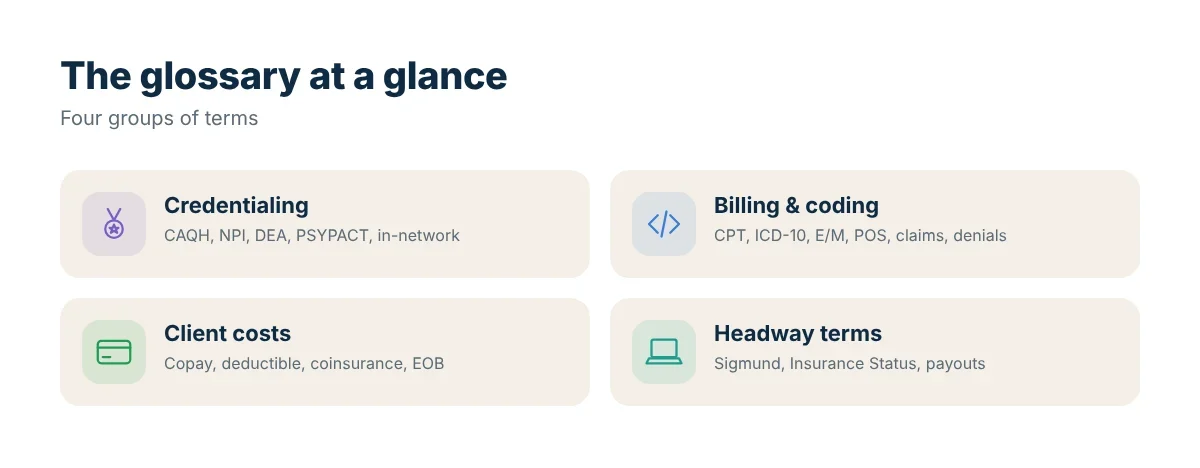
Credentialing terms
CAQH ProView – An online database where providers store credentialing information that insurers (and Headway) use to verify them. Most insurers expect you to re-attest regularly.
Credentialing – The insurer’s process of verifying your license, education, insurance and history before you can bill as in-network. See our credentialing guide.
Recredentialing – Repeating verification on a cycle; about every three years on Headway. See recredentialing.
In-network / paneled – You have a contract (directly or through Headway) to bill a specific insurer at agreed rates.
NPI (National Provider Identifier) – A unique 10-digit ID for US healthcare providers. Type 1 is for individuals; Type 2 is for organisations.
DEA registration – Federal registration required to prescribe controlled substances.
CDS registration – A state-level controlled substance registration required in some states.
PSYPACT – An interstate compact for psychologists. Headway says it does not count as a license for insurance credentialing.
Malpractice (liability) insurance – Professional insurance required for credentialing. Headway asks for current coverage and a 10-year history.
Billing and coding terms
CPT code – A code describing the service, such as 90834 for a 45-minute psychotherapy session. See our CPT guide.
ICD-10 code – The diagnosis code that supports medical necessity.
E/M code – Evaluation and management codes (such as 99213) used mainly by prescribers.
Add-on code – A code billed together with a primary code, such as 90785 (interactive complexity).
Place of service (POS) – Where the service happened: 11 office, 10 telehealth at home, 02 telehealth elsewhere.
Modifier – A two-character code added to a CPT code to give extra information, for example for telehealth.
Claim – The bill sent to the insurer after a session. Headway submits claims for you. See how claims work.
Denial – The insurer refuses to pay a claim, for example because coverage ended.
Prior authorization – Insurer approval required before certain services on some plans.
Coordination of benefits (COB) – Rules for which plan pays first when a client has more than one. Headway bills primary insurance only.
Session confirmation – In Sigmund, entering the CPT code, diagnosis and note after a session so Headway can bill and pay you.
Client cost terms
Copay – A flat amount per session.
Deductible – What the client pays before insurance contributes, usually reset yearly.
Coinsurance – The client’s percentage of the cost after the deductible.
Out-of-pocket maximum – A yearly cap on the client’s costs.
EOB (Explanation of Benefits) – The insurer’s statement showing what was billed, paid and owed.
Full cost of care – The rate Headway has agreed with the insurer, charged when insurance does not cover a session.
Out-of-network (OON) – A plan or provider outside the network. Headway does not work with out-of-network benefits.
EAP (Employee Assistance Program) – An employer-funded benefit with a limited number of sessions, separate from regular health insurance.
Medicare Advantage – Private plans that provide Medicare benefits. Headway accepts select plans; it does not accept Original Medicare (Part B).
Medicaid managed care – State Medicaid benefits delivered through private plans; Headway accepts select plans in some states.
Headway-specific terms
Sigmund – Headway’s provider portal at sigmund.headway.co. See what is Sigmund.
Insurance Status page – Shows when each carrier has approved you and your guaranteed-payment date.
Sigmund Lite – A limited access level for clinicians in a group practice. See group practices on Headway.
Payout – Headway’s twice-monthly payment to providers on the 15th and last day of the month.