Headway for Psychiatrists and Psychiatric Nurse Practitioners
Last reviewed: October 30, 2026
Headway’s network includes prescribers as well as therapists. Psychiatrists and psychiatric mental health nurse practitioners (PMHNPs) go through the same core credentialing process, plus some extra requirements. This guide pulls together what Headway says prescribers need to know.
Extra credentialing requirements for prescribers
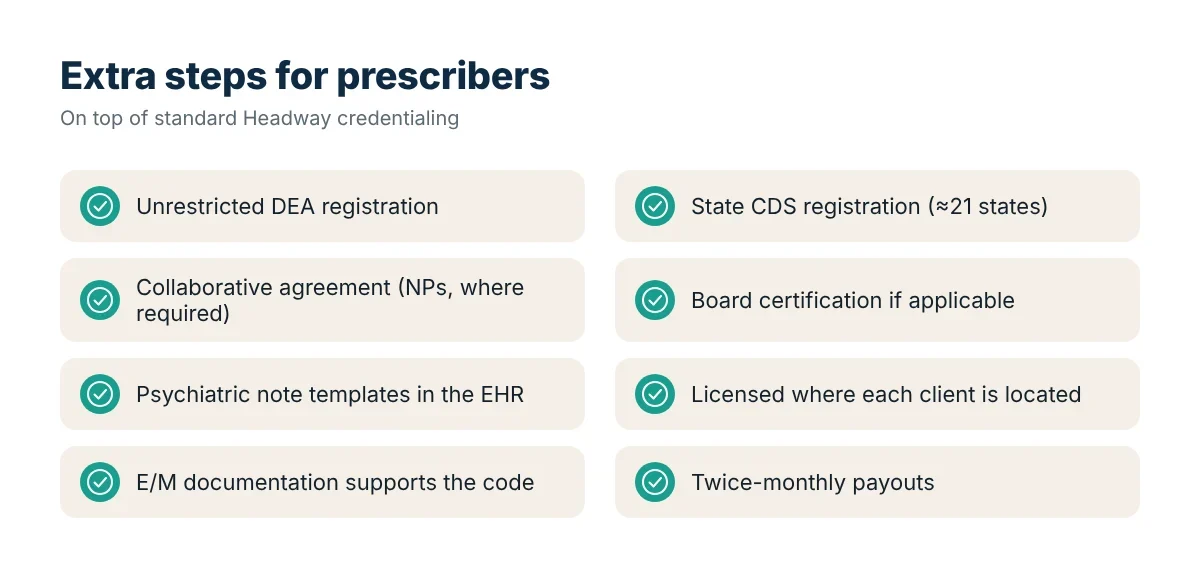
On top of the standard documents (NPI, CAQH, licenses, malpractice history, work history), Headway’s credentialing guidance says prescribers need:
- An unrestricted DEA registration in every state where you are licensed and prescribe, including your primary state.
- A state CDS (controlled dangerous substance) registration in around 21 states that require one, such as Alabama, Connecticut, Illinois and Massachusetts.
- A collaborative practice agreement with a physician for nurse practitioners in states that require one.
Headway says it guides prescribers through DEA licensing, board certification and collaborating-physician agreements during onboarding. Full credentialing details are in our credentialing guide.
Documentation
Headway’s EHR includes psychiatric note templates for intake visits, medication management and telepsychiatry. If you prefer your existing EMR or e-prescribing tool, Headway says it works with many of them, so you do not have to switch.
Billing codes prescribers commonly use
Prescribers typically use evaluation and management (E/M) codes for medication management, sometimes with a psychotherapy add-on:
| Code | Typical use |
|---|---|
| 90792 | Psychiatric diagnostic evaluation with medical services (intake) |
| 99212–99215 | Established patient E/M visits (medication management), by complexity or time |
| 90833 / 90836 / 90838 | Psychotherapy add-on to an E/M visit (about 30 / 45 / 60 minutes) |
Always follow payer rules and document medical decision-making or time to support the E/M level. See our CPT code guide for therapy codes.
Telepsychiatry rules
The same location rules apply as for therapists: you must be licensed and credentialed where the client is physically located, sessions must use audio and video, and they cannot be held from outside the U.S. See telehealth on Headway. Prescribing controlled substances via telehealth is also subject to DEA and state rules, which you should check independently.
Payments
Prescribers are paid on the same twice-monthly schedule as other providers, and Headway says it does not charge providers to use its platform. Rates vary by license type, plan and location. See how Headway pays providers.
Is Headway a good fit for prescribers?
Potential advantages: credentialing handled for you, predictable payouts, built-in psychiatric templates and referrals from Headway’s directory.
Consider: rates set by Headway, insurance documentation requirements for E/M levels, and state-specific collaborative-practice and controlled-substance rules that remain your responsibility.
FAQ
Do PMHNPs need a collaborating physician to join Headway?
Only in states that require collaborative practice agreements for nurse practitioners.
Can I keep my own e-prescribing software?
Headway says it works with many EMR and e-prescribe tools, so you can keep your existing systems.
Do prescribers get paid on the same schedule?
Yes, on the 15th and the last day of each month.
Sources: Credentialing with Headway, Headway – psychiatric practice benefits, Telehealth on Headway.