How Headway Claims Work: Submission, Delays and Denials
Last reviewed: October 30, 2026
Headway handles insurance claims on behalf of its providers, so most clinicians never touch a claim form. Still, understanding the process helps you answer client questions and spot problems early. This guide follows a claim from booking to the final Explanation of Benefits (EOB).
The claim lifecycle
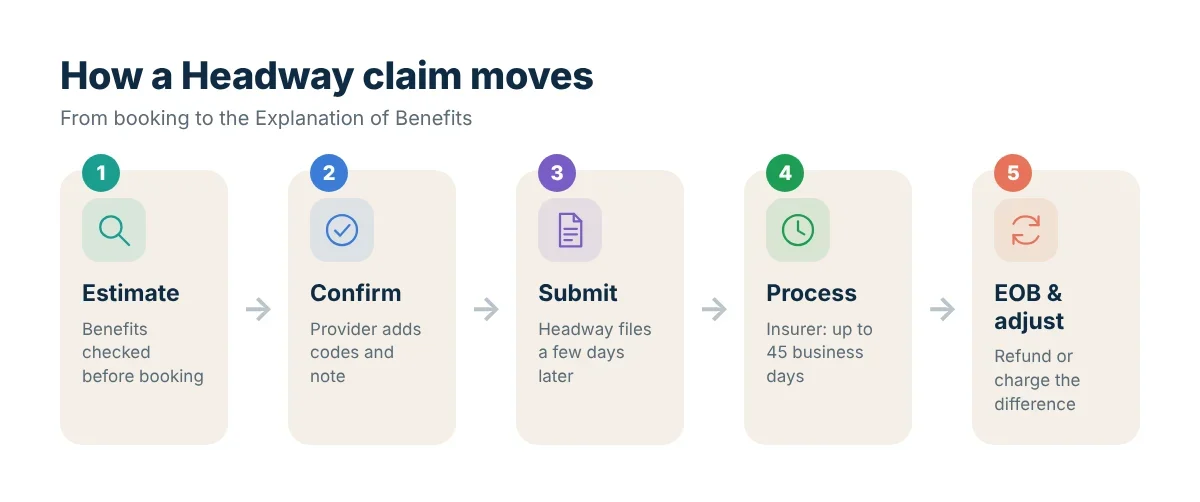
- Eligibility and estimate. When a client enters insurance details, Headway looks up their mental health benefits and shows a cost estimate before booking.
- Session and confirmation. After the session, the provider confirms it in Sigmund with a billing (CPT) code, diagnosis code and note. The client is charged their share.
- Submission. Headway submits the claim a few days after the session is confirmed.
- Insurer processing. The insurer can take up to 45 business days to process it.
- EOB. The insurer sends the client an Explanation of Benefits.
- Final adjustment. If the insurer’s final amount differs (for example, because a deductible was or was not met), Headway refunds overcharges and charges undercharges to the card on file.
Providers are paid on Headway’s own schedule rather than waiting for step 6. See the payment schedule guide.
Why claims get delayed
Delays usually mean the client receives no EOB yet, the insurer says there is no claim on file, or the session takes longer to appear in the insurer’s portal. Common causes:
- The provider is not yet in the insurer’s system. Headway holds claims until the provider is added, because early submissions are often denied.
- Incorrect client information. A wrong member ID, date of birth or name stops submission until Headway corrects it.
- Insurer contract updates. Submissions may pause while an insurer updates its systems.
Why claims get denied
| Reason | What happens |
|---|---|
| Coverage inactive or terminated | Client may be charged the full cost of care unless they add an active plan or switch to private pay |
| Plan is out-of-network | Client owes the full cost and is emailed and charged |
| Plan does not cover mental health or telehealth | Same as above |
| Coordination of benefits issue | Headway bills primary insurance only; a secondary plan on file can trigger a denial |
| Annual session limit reached | Client owes the full cost for further sessions |
“Full cost of care” is the rate Headway has agreed with the insurer for that service.
What providers can do to prevent problems
- Confirm sessions promptly with accurate CPT and ICD-10 codes. See our CPT code guide.
- Ask clients to keep insurance details current, especially in January when plans often change.
- Check the client’s telehealth location is in a state where you are credentialed.
- Watch for documentation feedback on Medicare Advantage claims, which are not submitted until notes are compliant.
- Collect prior authorizations where a plan requires them.
What to tell a client who asks about a claim
Clients do not need to track claims themselves, but if they want to:
- Call the insurer with their member ID, date of birth and session date and ask about the claim.
- If the insurer cannot find it, contact Headway support with the call reference number.
- If an EOB shows a denial or a wrong charge, contact Headway, which will work with the insurer.
FAQ
Who submits claims on Headway?
Headway does, a few days after the provider confirms the session.
How long does an insurer take to process a Headway claim?
Up to 45 business days, according to Headway’s Help Center.
Does a denied claim affect my pay?
Headway says it pays providers on schedule whether or not the insurer pays, and absorbs denied claims. The client may be billed in some denial cases described above.
Source: Understanding the claims process.