Common Therapy CPT Codes Explained for Headway Providers
Last reviewed: October 30, 2026
When you confirm a session in Sigmund, you must enter a CPT code. CPT (Current Procedural Terminology) codes tell the insurer what service you provided. Choosing the right one matters: the wrong code can lead to a denial, an incorrect client charge or an audit.
This is a general reference based on the standard AMA code set. It is not billing or legal advice. Always follow your payer contracts, Headway’s guidance and your own clinical judgment.
Diagnostic evaluation codes
| Code | Service | Typical use |
|---|---|---|
| 90791 | Psychiatric diagnostic evaluation (no medical services) | Intake session for therapists |
| 90792 | Psychiatric diagnostic evaluation with medical services | Intake by a prescriber (psychiatrist, PMHNP) |
Individual psychotherapy codes
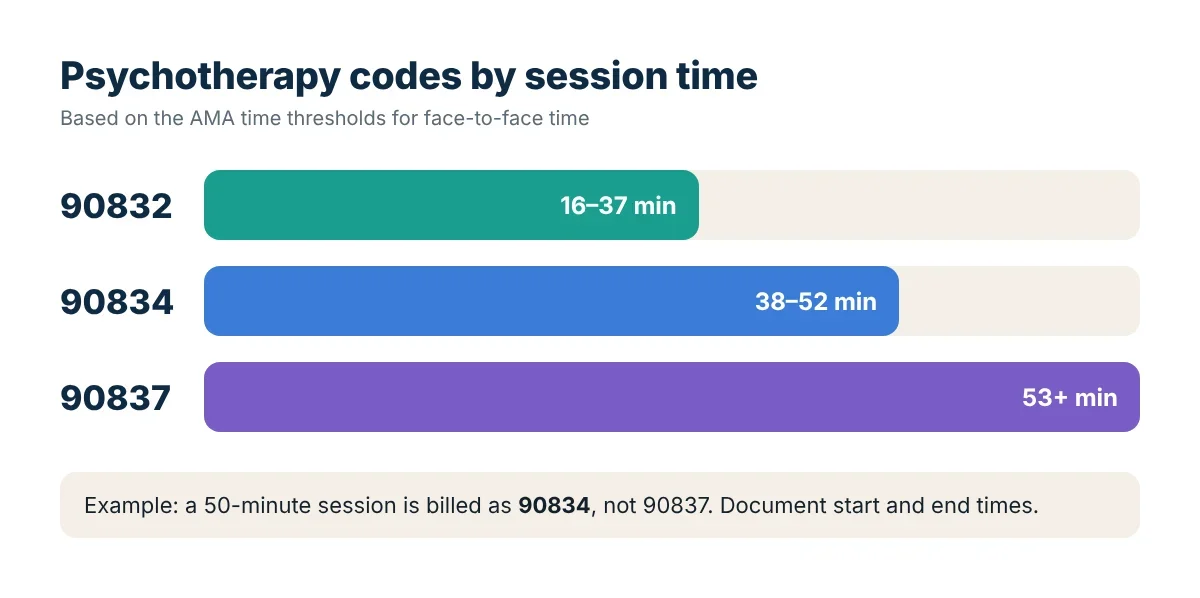
Psychotherapy codes are based on face-to-face time with the client (and/or family member). The AMA “midpoint rule” sets the minimum time for each code:
| Code | Description | Time range |
|---|---|---|
| 90832 | Psychotherapy, 30 minutes | 16–37 minutes |
| 90834 | Psychotherapy, 45 minutes | 38–52 minutes |
| 90837 | Psychotherapy, 60 minutes | 53 minutes or more |
A 50-minute session is therefore billed as 90834, not 90837. Document start and end times in your note so the time supports the code.
Family and couples therapy codes
| Code | Description |
|---|---|
| 90846 | Family psychotherapy without the patient present (50 minutes) |
| 90847 | Family psychotherapy with the patient present (50 minutes) |
Coverage for couples therapy varies a lot between plans, so verify benefits first.
Add-on codes
Add-on codes are used together with a primary code, never on their own:
- 90785 – Interactive complexity. For sessions where communication factors make the service harder, such as managing conflicting caregivers or using play equipment with a child. It needs clear documentation.
- 90833 / 90836 / 90838 – Psychotherapy with an E/M service. Used by prescribers who provide psychotherapy in the same visit as medication management (for example 99213 + 90833).
Crisis codes
- 90839 – Psychotherapy for crisis, first 60 minutes (30–74 minutes)
- 90840 – Each additional 30 minutes
Telehealth
For telehealth sessions, insurers often require a place of service code (such as 02 or 10) and sometimes a modifier (such as 95). Requirements differ by payer and change over time, so follow the options Headway shows when you confirm a session.
Documentation that supports your code
- Session start and stop times
- Who attended (client, family member)
- Diagnosis (ICD-10) linked to the service
- Interventions used and the client’s response
- Plan for the next session
For Medicare Advantage clients, Headway also requires a diagnostic statement in every note and a treatment plan within 14 days. See our Medicare guide.
FAQ
Can I bill 90837 for every session?
Only when the face-to-face time is 53 minutes or longer and it is documented. Payers watch for unusually high 90837 use.
Which code do I use for the first session?
Usually 90791 for therapists and 90792 for prescribers.
Where do I enter the CPT code on Headway?
When you confirm the session: click the past session in your Calendar, choose “Confirm Details” and add the CPT code, diagnosis and note. See your first session on Headway.
References: AMA CPT code set; Headway – First session with a client.