Telehealth on Headway: Licensing, Client Location and Platform Rules
Last reviewed: October 30, 2026
Most Headway sessions happen over video. Telehealth is convenient, but insurance rules follow the client’s physical location, not yours. Getting this wrong is one of the most common reasons sessions cannot be confirmed. Here are the rules from Headway’s Help Center.
The golden rule: where is the client?
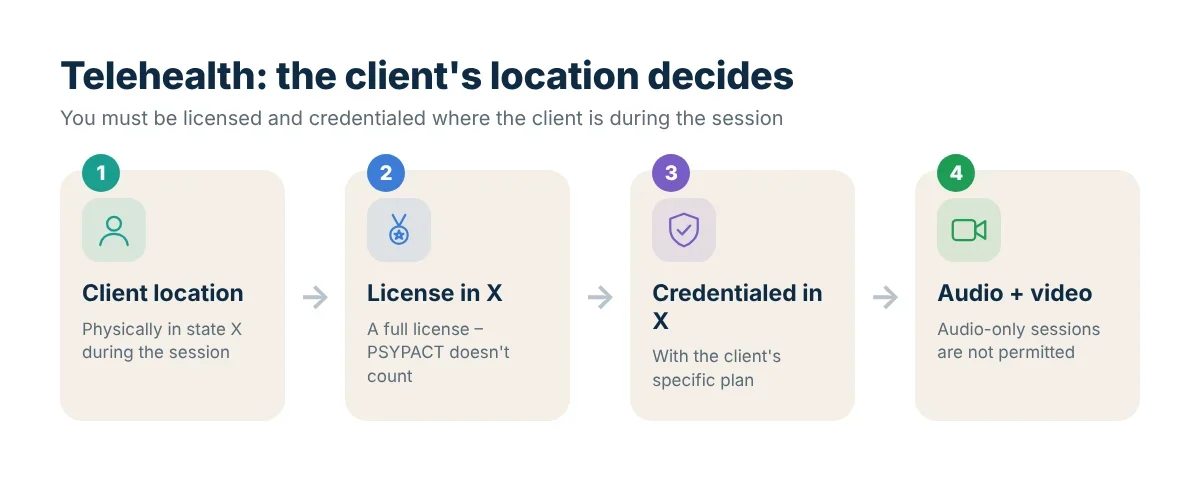
To bill insurance through Headway, you must be licensed and credentialed with the client’s plan in the state where the client is physically located during the session.
- You must enter the client’s location to confirm each telehealth session.
- You can join from anywhere in the U.S. where you are licensed and credentialed for the client’s location.
- Sessions cannot be conducted from outside the U.S.
- PSYPACT does not count as a license for insurance credentialing. You need a full license.
Approved video platforms
Headway names these acceptable options:
- Headway’s built-in telehealth
- Doxy.me
- HIPAA-compliant Zoom
- HIPAA-compliant Google Meet
Whatever you use, it must be HIPAA-compliant (with a Business Associate Agreement where required), encrypted over HTTPS and have a waiting room or private room so sessions don’t overlap.
Audio-only sessions are not permitted on Headway. Sessions must include both audio and video.
Adding your link
Go to Settings → Locations, paste your default telehealth link and optional instructions. Headway includes the link in reminders, confirmations and the client’s appointments page.
Place-of-service codes
| Code | Meaning |
|---|---|
| 11 | Provider’s office (in person) |
| 10 | Telehealth, client at home |
| 02 | Telehealth, client somewhere other than home |
In-person visits in a client’s home are not supported.
Travelling, commuting and relocating clients
- Commuting client: billable as long as the client is physically in a state where you are licensed and credentialed during the session.
- Travelling client: you must be licensed in the state where the client is during the session. Otherwise you cannot practise with them there.
- Client who moves: become licensed and credentialed in the new state, or refer them to a provider there.
- Crisis codes 90839/90840 cannot be billed through Headway if the client is outside a state where you are licensed and credentialed.
Out-of-network client locations
Headway says that from July 1, 2026 it blocks scheduling or confirming new sessions when a client’s location is out-of-network for you. Options include asking the client for an in-network address, up to two transition sessions (one waived session for Medicare and Medicaid clients) or switching to private pay.
Blue Cross Blue Shield is different
BCBS plans are organised state by state. The client must be within the plan’s service area and you must be credentialed with that plan in that state. BlueCard and some virtual networks can allow care outside a plan’s home area under specific conditions. Some Anthem plans also require you to live in the state for 183 days a year.
Telehealth checklist
- Confirm the client’s location at the start of every session.
- Keep each client’s location up to date in Clients → Billing → Virtual session locations.
- Use video, never audio-only.
- Choose the correct place-of-service code.
- Add new states through Insurance Status → Get credentialed if clients relocate.
FAQ
Can I see a Headway client who is on holiday in another state?
Only if you are licensed and credentialed in that state.
Are phone sessions allowed on Headway?
No. Headway does not permit audio-only sessions.
Can I do telehealth from abroad?
No. Headway says sessions cannot be conducted from outside the U.S.
Sources: Credentialing, licensing and location requirements, Telehealth on Headway.