
Headway for Clients: Copays, Deductibles and What Therapy Costs
Last reviewed: October 30, 2026
Headway helps people find therapists and psychiatric providers who take their insurance. But what will you actually pay per session? It depends on your plan. This guide explains the terms in plain English, based on Headway’s Help Center.
How Headway estimates your cost
When you add insurance to your Headway account, Headway looks up your mental health benefits and shows an estimated cost per session. The estimate depends on:
- Your insurance plan and its benefits
- The provider’s training (for example therapist vs psychiatrist)
- The provider’s location
- Session length and type
You see the estimate when booking and in appointment reminder emails. You are billed after the session, not before.
Insurance terms explained
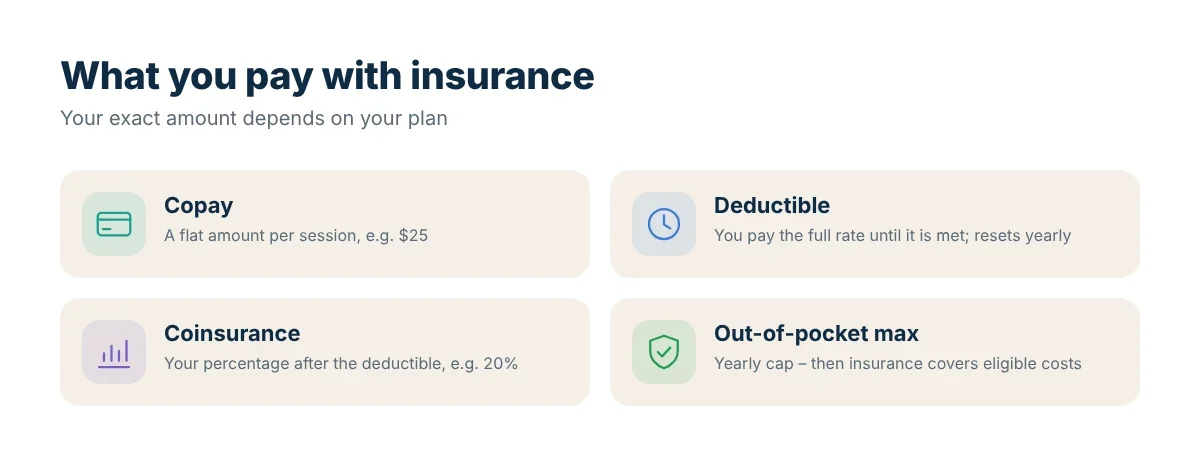
Copay
A flat amount per session, for example $25. It stays the same regardless of session type or length.
Deductible
The amount you pay before insurance starts contributing. It usually resets every year. Until you meet it, you pay the full negotiated session rate. Plans may have individual and family deductibles.
Coinsurance
After your deductible is met, insurance pays a percentage and you pay the rest, for example 20%.
Out-of-pocket maximum
Many plans cap what you pay in a year. Once you reach it, your insurer covers eligible costs until the plan resets.
Example
Suppose the negotiated rate for a session is $120, your deductible is $500 and your coinsurance is 20% (illustrative numbers only):
- Sessions 1–4: you pay the full $120 each ($480 total).
- Session 5: you pay the last $20 of the deductible, then 20% of the remaining $100 ($20), so $40 in total.
- Session 6 onwards: you pay 20% of $120 = $24 until you reach your out-of-pocket maximum.
Why the final charge can change
Your insurer makes the final decision after the claim is processed, which can take up to 45 business days. If you were charged too much, Headway refunds the difference. If you were charged too little (for example, the deductible had not actually been met), the difference is charged to your card on file. Check the Explanation of Benefits (EOB) your insurer sends you.
What if my insurance changes or ends?
Update your insurance on Headway straight away. Since June 1, 2024, sessions held without active insurance or an agreed private-pay arrangement can be charged at the full cost of care, the rate Headway has agreed with the insurer.
What Headway does not cover
- Out-of-network benefits
- Original Medicare (Part B)
- Plans that do not cover mental health or telehealth
- Sessions after an annual visit limit is reached
If your insurance is not accepted, ask a provider about private-pay rates.
FAQ
Does Headway charge a membership fee to clients?
Clients pay for sessions according to their insurance (or private-pay rate). Check Headway’s site for current details.
When am I charged?
After the session, using the payment method on file.
Which insurance does Headway take?
See our guide to insurance plans accepted on Headway.
Sources: Using insurance on Headway, Understanding the claims process.